
The Silent Survivors 2.0
Artwork by Rangga Purbaya
Curation by Juliane Okot Bitek
March 24th – 28th, 2026
State of Flux Gallery
Curatorial Statement
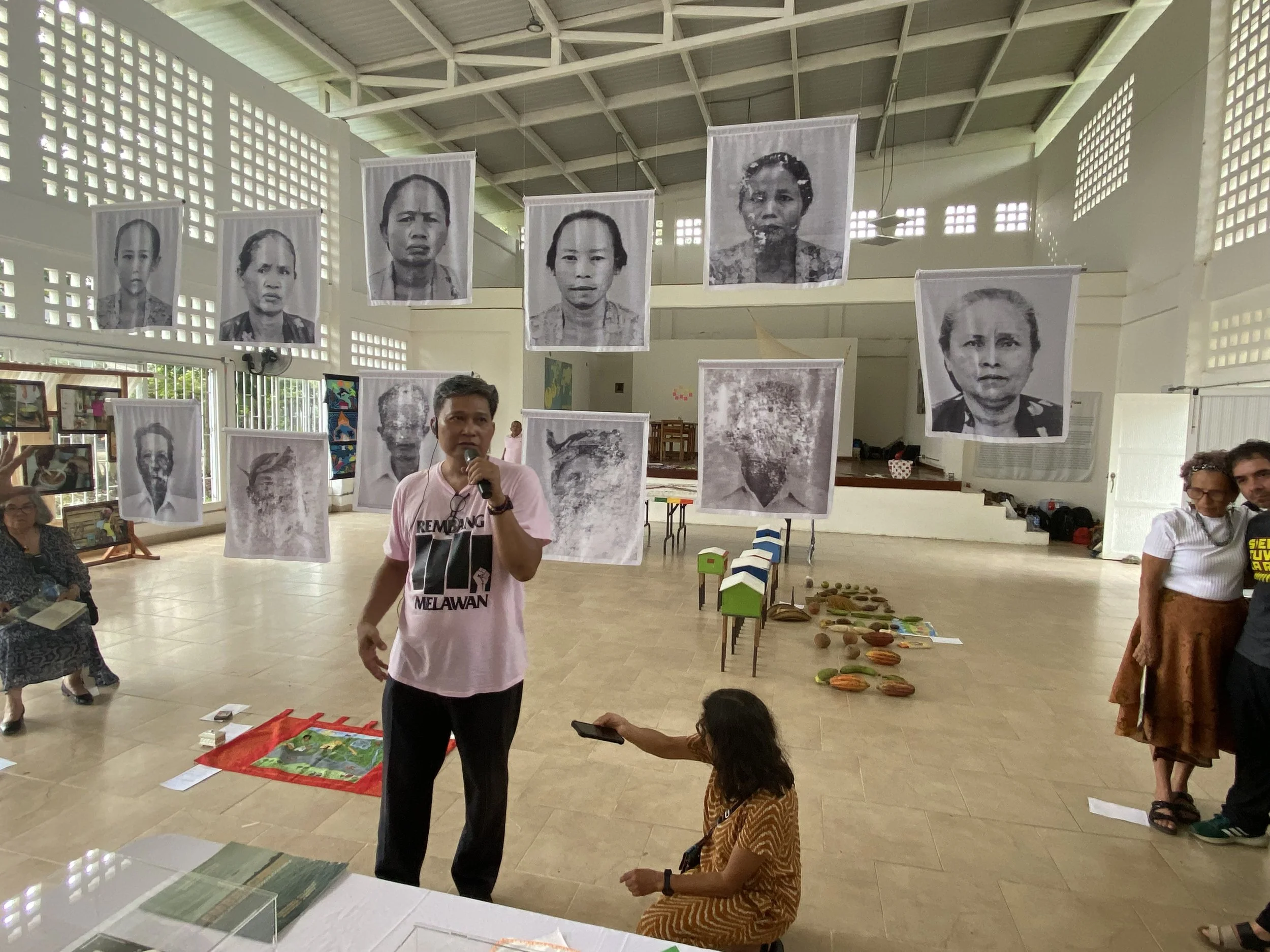
The Silent Survivors 2.0 is an extension of The Silent Survivors (2025) historical research project by the brilliant Indonesian artist Rangga Purbayan, a work that engages with the deep and painful memory of the 1965 massacres that targeted people who were believed to be members or affiliates of the Communist Party in Indonesia. Between 500,000 and 1,000,000 are believed to have lost their lives in these mass killings. Among the materials for this work are portrait photographs that were recovered from a flea market in Central Java, many of which have deteriorated through time but are invaluable in the continued conversation about the agency and resilience for those who have been disappeared through state violence and rendered silent, invisible, and often forgotten.
I met Rangga Purbaya in Turbo, Colombia, where we both attended a MemoLab, an annual gathering hosted by the Transformative Memory International Network. In Turbo, community leaders, Indigenous representatives, artists, scholars, students, and survivors of mass violence from Canada, Chile, Uganda, and Indonesia met under the theme of Embarcase: Ports, Flows, and the Undercurrents of Memory. Rangga’s portraits hung in the middle of a wider art exhibit, activated through conversation with other artworks, the breeze, and the exchange of voices and dance through the room.
In The Silent Survivors 2.0, we bring five of Rangga’s portraits into conversation with objects formerly used in programming at Agnes to think about the possibilities between material artifacts and images from disparate geographies. We, from GNDS 893/ENGL 813, offer copies of photographs to add to the conversation, and we invite you to offer some words/images back as we reflect on this space of memory.
Artist Statement
In the heart of forgotten echoes, The Silent Survivors arise—a poignant ode to those who weathered the Indonesian communist purge of 1965. This evocative journey delves into the silenced voices of ex-political prisoners, whose chains were forged through affiliations with the Indonesian Communist Party or kindred leftist dreams.
Unearthed portraits from Central Java, weathered by time and turmoil, reveal faces marred by humidity and neglect. These fragmented visages stand as somber testaments to their erasure from historical narratives and public memory. Yet, beneath the weight of untold pain, these souls shine with indomitable resilience and strength, their stories whispered through the cracks of history.
The Silent Survivors is a historical research project that examines the experiences of individuals who endured the 1965–66 anti-communist purges in Indonesia. Drawing on a unique assemblage of primary sources—photographic portraits and personal documents recovered from a flea-market stall in Central Java—this study reconstructs the lives of ex-political prisoners whose affiliations with the Indonesian Communist Party and other leftist movements led to their incarceration, disenfranchisement, and erasure from official narratives.
The material evidence, marked by humidity damage and the wear of neglect, provides an unusually direct window into a period whose archival record remains fragmentary. Weathered photographs capture visages long omitted from public memory, while accompanying letters, identification papers, and personal artifacts illuminate the quotidian dimensions of endurance, survival strategies, and acts of resistance. Together, they form a corporeal archive through which silenced voices can be heard once more.
By situating these recovered documents within broader socio-political and historiographical frameworks, The Silent Survivors contributes to ongoing debates on memory, trauma, and state-sponsored violence. It foregrounds the methodological challenges of working with non-institutional archives and underscores the ethical imperative to restore agency to those whom official histories have rendered invisible.
Juliane Okot Bitek
Otoniya Juliane Okot Bitek is the author of four books–three collections of poetry and a novel. Her most recent work is We, the Kindling (2025 Alchemy), a fictionalized account of women survivors of the Lord’s Resistance Army. She teaches at Queen’s University in Kingston, Canada, which occupies the lands of the Anishinaabe and the Haudenosaunee people.
Otoniya’s work has been published widely on-line, in print and in literary magazines such as Event, The Capilano Review, Room, Arc, Whetstone, Fugue, and recently anthologized in Love Me True: Writers Reflect on the Ups, Downs, Ins & Outs of Marriage, Transition: Writing Black Canadas, Great Black North; Contemporary African Canadian Poetry , Revolving City: 51 Poems and the Stories Behind Them, Settled/Unsettled for Cascadiamagazine.org.
Rangga Purbaya
Rangga Purbaya (b. 1976) is a visual artist from Yogyakarta, Indonesia. He graduated from the Photography department in the Indonesian Institute of the Arts, Yogyakarta. He considers art as a medium for reflection, a catalyzer for building reconciliation, and an agent for transformation. His work integrates different mediums, such as photography, text, mix-media, video installation, and performance. Collective memory, history, and archives are his primary research focus.
In the last five years, he was working with Indonesia’s 1965 genocide issues. Some of the projects are: Stories Left Untold, Investigating Boentardjo, Letter To The Lost One, and Landscape Of Deception. Rangga’s work has been featured in numerous gallery, art fair, and festival exhibition including Fête de l'Humanité, Unseen CO-OP Amsterdam, Jimei x Arles Photo Festival, Bangkok Photo Festival, ACC (Asia Culture Center), Goethe Institute Indonesien, and Ruang Mes 56.